




The shift in how people travel has been underway for years, but 2026 has made it impossible to ignore. Flights and hotels are now the logistical frame around a trip — the real product is what happens once you arrive. The global tours and experiences market is expected to grow from $253 billion in 2019 to $314 billion in 2026, with online penetration increasing from 16% to 31% during this period. The platform that has positioned itself most deliberately at the centre of that shift is Viator — and the numbers behind its recent performance confirm that the bet is paying off at scale.
What Viator Is and How It Works
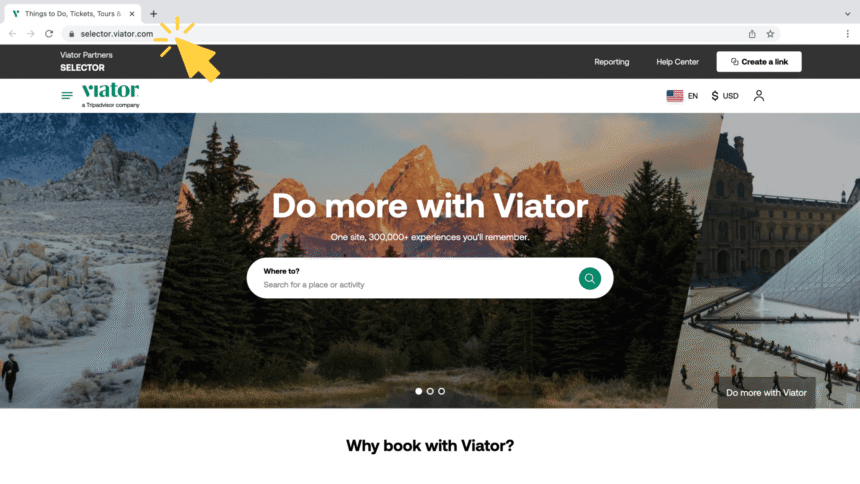
Viator lists approximately 400,000 experiences worldwide, works with more than 65,000 operators, and powers the experiences storefronts of thousands of websites, including some of the biggest names in travel. Founded in 1995 and acquired by TripAdvisor in 2014 for $200 million — a platform that could now be worth $2 billion — Viator operates as a global marketplace connecting travellers with tour operators, activity providers, and experience creators across every destination and every category of travel experience. The booking process is entirely digital: travellers search by destination or experience type, compare operator ratings and reviews, and complete the transaction through the platform, with confirmation sent directly to their mobile device.

This category is transforming — moving from a fragmented offline past to a seamless online future, as Viator’s incoming President Pepijn Rijvers described it at his appointment in April 2025. That transformation is the commercial thesis underpinning every product and technology decision the platform makes.
The Financial Performance That Commands Attention
Viator continued its strong growth trajectory with revenue reaching $270 million in Q2 2025, an 11% increase from $244 million in Q2 2024. The segment’s adjusted EBITDA more than tripled to $32 million from $10 million a year earlier. The number of booked experiences increased 15% to 6.2 million, while gross value of reservations reached $1.3 billion. These are not marginal improvements — tripling adjusted EBITDA in a single year reflects a platform that has crossed the profitability threshold while still growing its top line at double digits.
The platform’s scale advantage is its most durable competitive asset. The platform now offers approximately 400,000 bookable experiences, which the company claims is about four times more than its closest competitor. That inventory gap is compounding: more experiences attract more travellers, more travellers attract more operators, and more operators produce more experiences — a flywheel that becomes progressively more difficult for smaller competitors to interrupt.
What Travellers Are Actually Booking
Viator’s 2025 trends data reveals a consumer whose priorities have shifted meaningfully from passive sightseeing toward active, skill-building, and immersive participation. Cooking classes are one of Viator’s top 10 most popular experiences, and photography tours have nearly doubled in popularity. Craft classes have also seen impressive growth, jumping more than 50% over the past year. Craft classes, cooking classes, and dance lessons are Viator’s highest-rated experiences of the year, each boasting an average rating above 4.8 out of 5 stars.
The outdoor category is equally revealing. Thermal spas and hot spring experiences saw more than 40% growth year-over-year, making them one of Viator’s five fastest-growing categories. Concerts and special events saw a 50% jump in bookings over the past year, with the top five events including a Christmas and New Year concert in Vienna, a flamenco show in Madrid, and an Italian opera concert in Florence — confirming that culturally rich musical experiences are now a mainstream rather than niche booking category.
Geographically, Asia’s resurgence dominates the destination data. Since Asia reopened its borders after the pandemic, Viator has seen a steady increase in bookings to the region — up more than 50% last year. Japan, Thailand, and Vietnam are still Viator’s top destinations in the region, but China is quickly becoming a major hot spot. Beijing leads the way as Viator’s fastest growing destination, with demand for the city surging nearly 4x year-over-year.
New Tools, New Partnerships, and AI Integration
The Spring 2026 product release confirmed that Viator is investing seriously in both the traveller-facing and operator-facing sides of its platform. New tools introduced include an AI Product Builder for creating listings faster with AI-powered assistance, Pricing Sync to keep prices competitive with less manual work, Image Optimization Tools to improve listing performance with better visuals, and a TikTok Integration to meet new audiences on the world’s most popular discovery platform.

Strategic partnerships expanded to include global brands like Capital One, American Airlines, and Hopper — distribution alliances that place Viator’s 400,000 experiences directly in front of travellers at the point of flight booking and financial product redemption, dramatically widening the platform’s reach beyond its own organic traffic. The growing role of artificial intelligence in personalising the user experience and collaboration with companies like OpenAI and Google to keep brands visible in AI searches underscores how seriously the platform is treating the shift in how travellers discover experiences — through AI assistants rather than traditional search.
The Strategic Conversation Around Viator’s Independence
One of the most commercially significant stories surrounding Viator in 2025 and 2026 has been the investor pressure building around its relationship with TripAdvisor. Palliser Capital claims the company is stifling growth potential as it manages both a struggling legacy TripAdvisor business and Viator, a platform for experiences and its fastest-growing brand, arguing it is attempting to operate simultaneously as a value business and a growth business — and succeeding at neither. Viator was acquired by TripAdvisor in 2014 for $200 million and could now be worth $2 billion — a tenfold appreciation that reflects the experiences market’s explosive growth and the platform’s category leadership, and that makes the question of Viator’s long-term corporate structure one of the most watched decisions in online travel for 2026.
Regardless of how that corporate question resolves, Viator’s product trajectory is unambiguous. With a powerful combination of assets — Viator as the world’s largest experiences marketplace, TripAdvisor as the world’s most trusted travel planning platform, and the industry’s most extensive distribution network — the group is uniquely positioned to extend its lead in experiences. For travellers, the practical implication is a platform that is getting faster, more personalised, and more comprehensive with each product cycle — and that already covers more of the world’s bookable experiences than any competitor comes close to matching.