




The global wellness economy is valued at over $6 trillion, and within it, the supplements and sports nutrition segment is among the fastest-growing verticals worldwide. In India specifically, the dietary supplements market is projected to expand from ₹157 billion in 2023 to ₹491 billion by 2032 — a compound annual growth rate of over 13%. Very few companies are better positioned to capture that growth than HealthKart. Founded in 2011 by Sameer Maheshwari and Prashant Tandon in Gurugram, HealthKart has evolved from a specialist e-commerce retailer into a diversified, omnichannel house of nutrition brands — and its financial trajectory over the past three years makes it one of the most compelling growth stories in India’s consumer health sector.
The Financial Turnaround That Changes the Narrative
HealthKart’s recent financial performance demands attention. The company posted operating revenue of ₹1,021 crore in FY24 — its first year crossing the ₹1,000 crore milestone — and turned profitable with a net profit of ₹37 crore after three consecutive years of losses. FY25 accelerated that trajectory sharply: operating income rose to ₹1,313 crore with total income nearing ₹1,400 crore, and profit tripled to ₹120 crore. The cost discipline behind these numbers is equally important: total spending rose 23% to ₹1,273 crore, below the 29% increase in income, and HealthKart managed to lower its cost per rupee earned to Re 0.97, compared to ₹1.01 in FY24. That operational leverage — growing revenue faster than costs at scale — is the hallmark of a genuinely maturing business rather than a growth-at-all-costs story.
To date, HealthKart has raised $382 million in total funding from institutional investors including Peak XV Partners, Temasek, and Sofina, with a valuation of $500 million confirmed in its November 2024 funding round led by ChrysCapital and Motilal Oswal Alternates.
A Brand Portfolio Built for Multiple Consumer Segments
What makes HealthKart structurally distinctive is its brand architecture. Rather than operating as a single-label supplement company, HealthKart owns and manufactures eight nutritional brands including MuscleBlaze, The Protein Zone, TrueBasics, HKVitals, bGreen, Nouriza, and Gritzo. Each addresses a specific consumer segment with precision. MuscleBlaze, founded in 2012, dominates sports nutrition and holds a 25% share of India’s sports nutrition market — built on clinically researched products and an industry-first focus on protein authenticity and test certificates that established consumer trust before most competitors understood why it mattered. HKVitals leads the vitamins and minerals supplementation category online, commanding a 20% share of the online health supplement market, with strong positions in multivitamins, fish oil, biotin, and collagen. TrueBasics addresses the premium nutraceutical segment with advanced formulations, while bGreen serves the fast-growing plant-based nutrition market and Gritzo focuses specifically on children’s nutrition — a category that most supplement brands ignore entirely.
This portfolio approach insulates HealthKart from category-level volatility in a way a single-brand operator cannot replicate. When any one segment softens, the others absorb it.
The Omnichannel Infrastructure: Online and Offline, Together
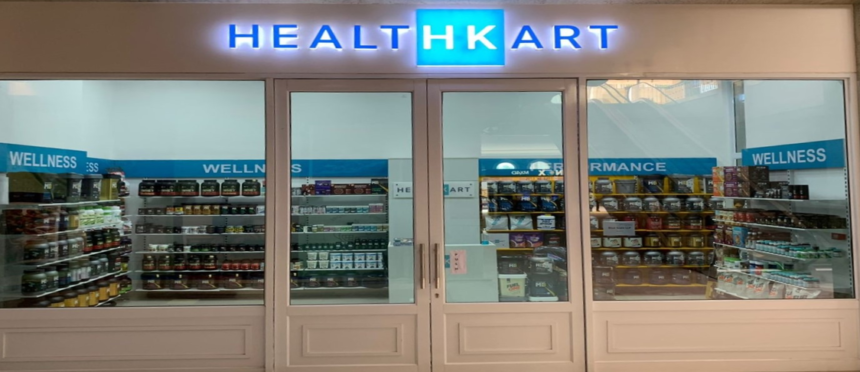
HealthKart’s distribution strategy is one of its most underappreciated competitive advantages. The company has surpassed 250 retail stores across 111 cities in India, reinforcing its offline expansion strategy and strengthening its position in the country’s rapidly growing health and wellness retail market. This physical footprint — which began with a single store in Punjabi Bagh, Delhi in 2013 — serves a dual purpose: retail distribution and in-person nutritional consultation, since many HealthKart stores also function as counselling centres where trained dieticians guide consumers on supplement selection. In parallel, the digital platform hosts over 20,000 SKUs across six categories, onboarding more than 1,000 local and global brands alongside its own proprietary labels.
The result is a genuine omnichannel ecosystem — not the loosely connected online-and-offline presence that most retailers describe as omnichannel, but an integrated infrastructure where the physical and digital channels reinforce each other in customer acquisition, trust-building, and repeat purchase behaviour.
Personalisation and Technology as Differentiators
HealthKart’s investment in technology-led personalisation has been consistent since it launched HealthKart Consult in 2016, combining AI-based diet recommendation engines with a network of dieticians and trainers to deliver supplement guidance at scale. The TeleConsult platform, launched in 2020, extended this to chat and audio support. In 2025, the company deepened its influencer marketing strategy through a partnership with KlugKlug, a leading influencer marketing SaaS platform, to amplify digital outreach across targeted wellness communities. Internationally, HealthKart signed a partnership with Ronnie Coleman Signature Series in September 2025 to expand premium sports nutrition access in India and South Asia — signalling growing ambitions beyond domestic brand development toward global brand curation.
What the Numbers and Strategy Signal for FY26
The convergence of a high-growth market, a diversified brand portfolio, a genuinely integrated omnichannel model, and three consecutive years of improving financial discipline puts HealthKart in a structurally strong position entering FY26. The primary risks are regulatory — potential restrictions on health claims for supplements — and competitive, as well-funded international entrants and domestic challengers scale their marketing spend. But with a cost-per-rupee metric now below ₹1, a proven ability to grow profits faster than revenue, and a brand portfolio that spans athletes, women, children, vegans, and mainstream wellness consumers simultaneously, HealthKart’s ambition to become India’s definitive house of nutrition brands has never been more credible.