





There is a lot of excitement around vertical AI right now, and for good reason.
Instead of building another general-purpose chatbot, startups are creating AI products for specific industries: healthcare, legal services, insurance, construction, finance, real estate and countless others. These companies understand the language, workflows and pain points of a particular profession. In theory, that specialization should give them a powerful advantage.
But there is a less glamorous part of the story.
A vertical AI startup can build an impressive product and still struggle to become a durable business if it ignores the horizontal software underneath it.
That is where horizontal SaaS platforms come in.
Vertical AI Solves the “What,” SaaS Often Handles the “How”
Think about a legal AI startup. Its technology might review contracts, summarize case files or identify unusual clauses in seconds. That is the part customers immediately notice.
But a law firm also needs user accounts, billing, permissions, document storage, calendars, communication, analytics and integrations with other systems. None of these features may be the company’s core innovation, but customers still expect them to work.
This is the quiet job of horizontal SaaS.
Platforms built for broad business needs—such as customer relationship management, payments, collaboration, identity management, accounting and cloud infrastructure—provide the basic machinery that specialized AI companies can build on.
Without that machinery, a startup may spend enormous amounts of time rebuilding ordinary software instead of improving the AI that makes it different.
AI Doesn’t Remove the Need for Infrastructure
There is a temptation to believe that AI changes everything.
In some ways, it does. AI can automate tasks that previously required hours of human work. It can interpret unstructured information, generate content and interact with software in increasingly sophisticated ways.
But AI applications still need infrastructure.
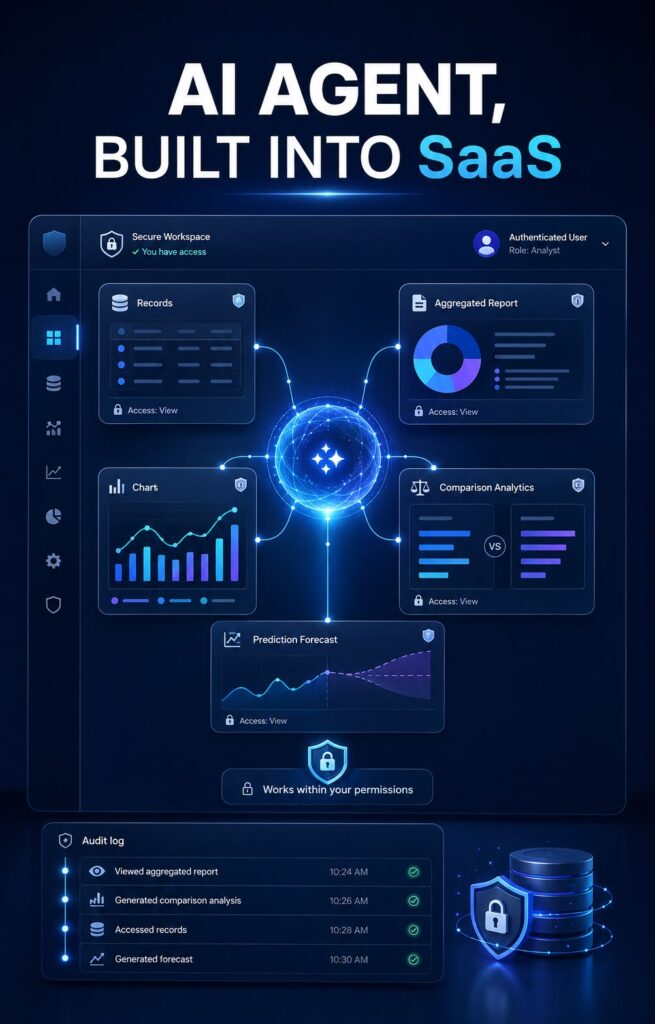
They need secure databases. They need authentication. They need payment systems. They need APIs. They need monitoring and analytics. They need ways to communicate with customers and connect to existing business software.
The more successful a vertical AI product becomes, the more demanding these requirements usually become.
A healthcare AI company, for example, cannot simply focus on making its model smarter. It has to think about privacy, permissions, audit trails and integration with existing healthcare systems. The AI may be the headline feature, but the surrounding software determines whether the product can actually operate inside a customer’s business.
Horizontal Platforms Also Speed Up Growth
There is another reason this relationship matters: speed.
Startups rarely have unlimited engineering resources. Every feature they build internally consumes developer time, money and management attention.
Using established SaaS infrastructure can allow a small team to launch much faster.
Instead of spending six months building an internal billing system, a startup can integrate a payments platform. Instead of developing authentication from scratch, it can use an identity provider. Instead of creating an entire customer-support system, it can connect an existing tool.
That doesn’t mean startups should outsource everything.
The trick is knowing what customers are paying them for.
If the competitive advantage is an AI system that understands insurance claims better than generic software, then building a sophisticated internal invoicing platform probably isn’t the best use of engineering resources.

The Relationship Works Both Ways
Interestingly, the dependence isn’t entirely one-sided.
Horizontal SaaS companies also have a reason to pay attention to vertical AI startups.
Specialized AI applications can become important distribution channels for horizontal platforms. If thousands of businesses use a particular AI application, the underlying SaaS providers connected to that application can benefit as well.
This creates an ecosystem rather than a simple supplier relationship.
The horizontal platform provides the foundation. The vertical application adds industry-specific intelligence. Customers get a product that feels specialized without requiring every company to build its own technology stack.
The Real Competitive Advantage May Be the Combination
The future of enterprise software probably won’t be divided neatly into “AI companies” and “SaaS companies.”
The more interesting businesses may combine both.
Vertical AI brings specialization. Horizontal SaaS brings infrastructure, reliability and scale. One understands the industry’s unique problems; the other provides much of the machinery needed to solve them consistently.
For founders, the lesson is fairly practical: don’t confuse the most visible part of your product with the entire product.
The AI may be what attracts customers, but dependable software is what keeps the business running.
And as the vertical AI market matures, that distinction could become increasingly important. The winners may not be the companies that build everything themselves, but the ones that know exactly what they need to own—and what is smarter to build on top of.